
When a Child’s Financial Life Becomes a Source of Exploitation
Updated: 1 day ago
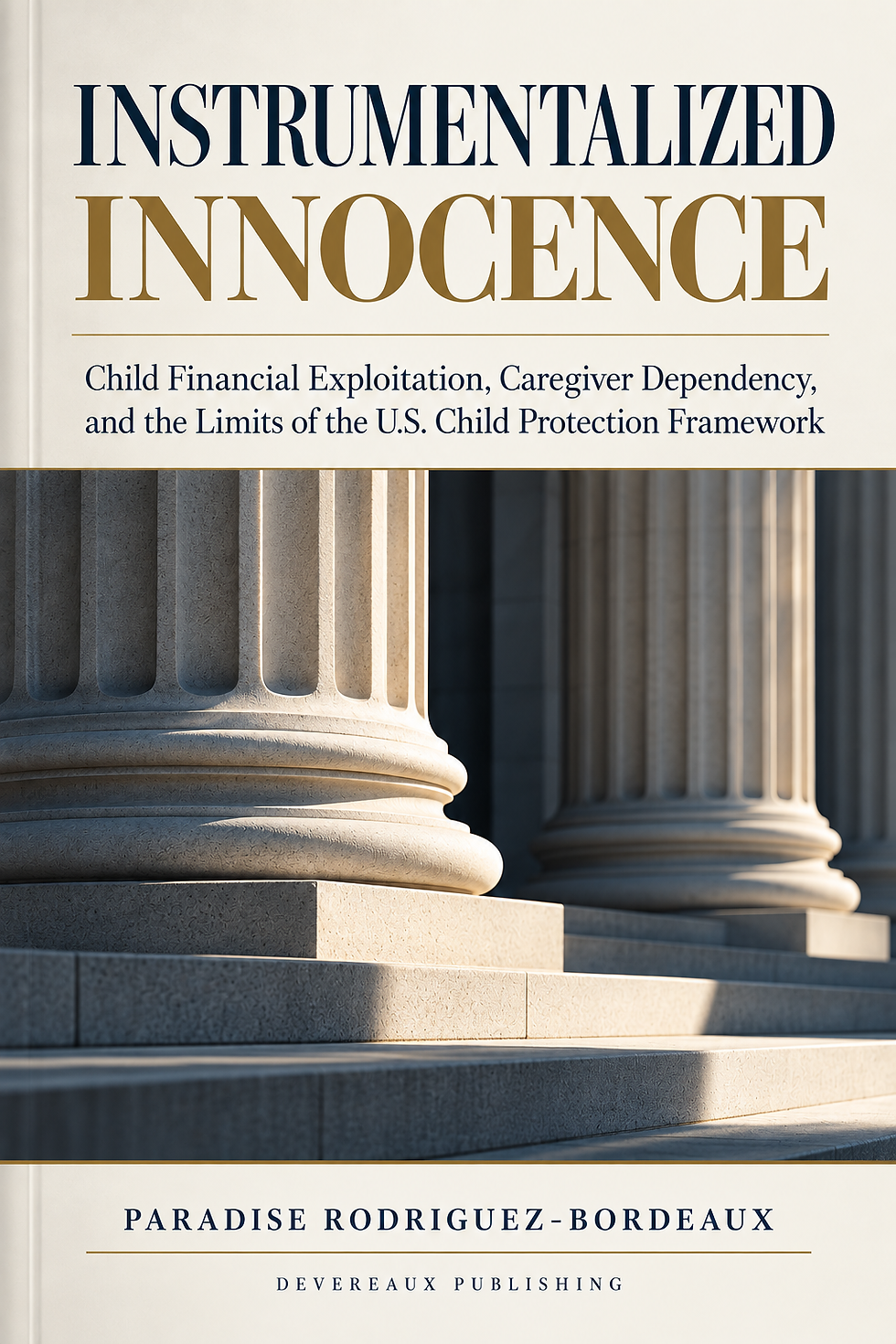
How caregiver dependency can conceal economic harm, compromise children's financial interests, and create consequences that extend into adulthood.
A child may enter adulthood carrying financial consequences from decisions made long before they had the authority or practical ability to understand them. Unauthorized accounts may have been established using their identifying information, earnings may have been diverted for another person's benefit, or years of economically valuable labor may have taken place without adequate safeguards for their interests. In some circumstances, these arrangements develop within the household itself, where the adult controlling the child's financial resources also exercises authority over their daily life, relationships, and access to assistance.
The possibility of exploitation within caregiving relationships presents a challenge for conventional approaches to financial abuse. Children occupy a dependent economic position, and the adults responsible for their welfare routinely manage resources, documents, and decisions on their behalf. These responsibilities are generally necessary and legitimate, yet they can also create opportunities for misuse when caregiving authority and personal financial interests conflict. Determining whether an arrangement is exploitative requires examining the child's legal rights, developmental circumstances, degree of choice, and the distribution of economic benefits and burdens.
My 2026 research paper, Instrumentalized Innocence: Child Financial Exploitation, Caregiver Dependency, and the Limits of the U.S. Child Protection Framework, examines these relationships through an interdisciplinary analysis of child maltreatment, consumer protection, labor regulation, property rights, economic coercion, and emerging forms of digital commerce. The paper develops child financial exploitation as an analytical category encompassing the misuse of a minor's identity, labor, earnings, assets, economic rights, or dependent position for another person's financial or material benefit under circumstances that compromise the child's interests, agency, or developmental position (Rodriguez-Bordeaux, 2026).
The significance of this approach lies in the relationship between economic conduct and the authority that enables it. A financial transaction may appear ordinary when viewed independently, while its broader circumstances reveal that the child had limited knowledge, meaningful choice, or access to independent protection. Understanding those circumstances is essential to distinguishing legitimate family economic interdependence from potentially exploitative conduct.
Childhood Dependency and Economic Control
Children's economic lives are closely connected to the decisions of adults. Parents and guardians may hold identification documents, administer financial accounts, supervise employment, manage property, and determine how household resources are distributed. Although these arrangements generally support a child's welfare, they can also restrict the child's ability to independently monitor financial activity or challenge decisions affecting their economic interests. The resulting vulnerability is especially important when the person controlling the resources may also benefit from their misuse.
Research on economic abuse has historically concentrated on adult intimate relationships, leaving children's experiences comparatively underexamined. Bruno (2022), in a review of the literature, identified direct and indirect economic victimization affecting children and young people, including circumstances associated with domestic abuse and parenting. The review demonstrates the importance of considering children's economic experiences within dependent relationships, while acknowledging limitations in the available research.
These limitations have practical implications. An adult experiencing financial abuse may possess the legal capacity to review credit records, establish accounts, dispute transactions, or seek independent financial assistance, even when coercion substantially restricts the ability to exercise those rights. Children generally have less independent access to these mechanisms and may depend on caregivers to obtain information or pursue remedies. Where the caregiver is implicated in suspected misuse, that dependency can complicate both recognition and disclosure.
Economic control can also operate alongside broader patterns of psychological coercion. Katz (2016) examined how children living with domestic violence may be harmed by nonphysical forms of coercive control, including isolation, monitoring, and emotional or financial abuse. Although that research does not establish the prevalence of child financial exploitation, it provides relevant evidence that children's autonomy and well-being can be affected by controlling family environments without a discrete incident of physical violence.
A related concern arises when children assume responsibilities ordinarily associated with adults. Keny and Banerjee (2026), in a systematic review of 69 studies on parentification, identified recurring findings involving psychological distress, family relationships, identity formation, well-being, and vulnerability to risky behaviors. The review also emphasized the importance of social and cultural context. These findings support careful examination of circumstances in which children become responsible for meeting adult economic needs, without implying that ordinary household responsibilities or contributions are inherently harmful.
Together, these bodies of research help explain why financial exploitation during childhood cannot be evaluated solely by identifying who received money or performed work. The conditions under which economic value was obtained, the authority exercised over the child, and the consequences of resistance are equally relevant.
Four Forms of Child Financial Exploitation
Instrumentalized Innocence identifies four principal modalities through which child financial exploitation may occur: identity-based financial exploitation, exploitative participation in family or caregiver-controlled enterprises, extraction of earnings and assets, and psychological coercion used to obtain economic compliance. These categories describe mechanisms that may overlap within the same relationship. They provide a structure for examining suspected harm while preserving the legal distinctions that determine whether particular conduct violates applicable law (Rodriguez-Bordeaux, 2026).
Identity-Based Financial Exploitation
Identity-based financial exploitation occurs when a child's identifying information is used without lawful authority to obtain credit, services, accounts, benefits, or other economic value. Parents and guardians ordinarily possess the documents necessary to manage a child's affairs, including Social Security numbers, birth certificates, and other identifying records. Legitimate access to those documents, however, does not necessarily authorize their use for an adult's personal financial purposes.
The involvement of family members can make identity misuse particularly difficult to recognize.
Navarro and Higgins (2017) examined familial identity theft using the 2012 Identity Theft Supplement to the National Crime Victimization Survey. Their findings identified differences between familial and nonfamilial identity-theft victimization. Because the study was not limited to minors, it does not establish how frequently caregivers commit identity theft against children. Its relevance lies in documenting identity-related victimization within family relationships.
Research focused specifically on minors provides additional evidence. Gyourko and Greeson (2023) analyzed linked child-welfare and consumer-credit records for a statewide cohort of 1,176 foster-care adolescents aged 14 to 17 in a mid-Atlantic state. Their study identified demographic and placement-related factors associated with identity-fraud victimization, illustrating the value of financial-record review in detecting potential harm among adolescents. The findings are limited to the population and setting studied and should not be interpreted as a national estimate of child identity theft.
Existing consumer-protection law provides mechanisms for prevention and correction. Under federal law, an authorized representative may request a free security freeze for a child younger than 16, even when a credit-reporting agency must first create a record for purposes of administering the freeze. Young people aged 16 or 17 may request a freeze themselves. These protections can help restrict unauthorized access to credit records, although they do not prevent every form of identity misuse or eliminate fraudulent accounts already established.
For affected children, unauthorized transactions or inaccurate records may become apparent only when they begin independently accessing financial services. Addressing those problems can require contact with financial institutions, consumer-reporting agencies, and other relevant organizations. The specific remedies depend on the nature of the misuse and applicable law, making early identification and accessible corrective procedures important considerations.
Exploitative Participation in Family Enterprises
Participation in a family business can provide adolescents with employment experience, practical skills, and opportunities to develop responsibility. Such participation is not inherently exploitative, and family relationships alone do not determine whether work is lawful or developmentally appropriate. The relevant assessment concerns the nature of the activity, applicable labor protections, occupational risks, compensation arrangements, and the child's ability to participate without coercion.
The potential conflict becomes more pronounced when caregivers simultaneously supervise the child's work, control business revenue, determine compensation, and regulate the child's access to resources. In these circumstances, an adult may occupy both a protective role and a position of direct economic benefit. That overlap does not establish wrongdoing, but it creates a reason to examine how decisions are made and whether the child's interests receive appropriate consideration.
Federal child-labor law illustrates the importance of distinguishing family employment from exploitation. Under specified circumstances, the Fair Labor Standards Act permits parents to employ their own children under rules that are less restrictive than those governing other employers. The parental-employment exception does not permit work in manufacturing, mining, or occupations declared hazardous for minors. Applicable state requirements may impose additional restrictions.
These employment rules do not independently determine ownership of a child's earnings, authorize identity misuse, or resolve business liabilities and property rights. Accordingly, the analysis developed in Instrumentalized Innocence considers the intensity and developmental appropriateness of work, the child's motivation and practical ability to refuse, occupational safety, control over compensation, and the allocation of economic benefits. Exploitation becomes a concern when a child's participation is used to generate value for another person under conditions that compromise the child's interests or meaningful choice.
Extraction of Earnings and Assets
Children may acquire economic resources through employment, gifts, inheritances, settlements, entertainment contracts, or other arrangements. The legal treatment of these resources varies according to their source, the child's circumstances, and the governing jurisdiction. Parental management of a child's earnings or property therefore cannot be presumed unlawful merely because an adult exercises control.
State law demonstrates the complexity of these relationships. California Family Code § 7500 generally recognizes specified parental rights to the services and earnings of an unemancipated minor, subject to statutory qualifications and exceptions. Different provisions apply to certain entertainment and professional-sports contracts. Under California Family Code § 6752, covered contracts are generally subject to requirements that 15 percent of the minor's gross earnings be set aside and preserved for the minor, with exceptions and procedures established by the statute. These protections cannot be generalized to every child, jurisdiction, or source of income.
Financial exploitation may arise when an adult appropriates property legally belonging to a child without authority, circumvents statutory safeguards, creates unauthorized liabilities, or uses coercive pressure to obtain resources in which the child possesses a protected economic interest. Determining whether extraction has occurred requires identifying the child's legal interest, the adult's authority, the purpose of the transaction, and the circumstances under which control was exercised.
This distinction is important because legitimate financial contributions and exploitative extraction may appear similar when viewed without context. A child's contribution to shared household expenses does not independently establish exploitation. The analysis changes when financial demands involve unlawful appropriation, coercion, misuse of protected assets, or other circumstances that compromise the child's interests.
Psychological Coercion and Economic Compliance
Economic exploitation may occur through pressure embedded in family relationships rather than through an openly unauthorized transaction. A child may be expected to provide money, perform economically valuable labor, or assume responsibility for an adult's financial difficulties because refusal carries emotional or relational consequences. Guilt, threats of rejection, withdrawal of approval, and assertions of family indebtedness can influence a child's apparent agreement, particularly when the adult applying pressure also controls essential support.
Research on coercive control and parentification helps explain the developmental significance of these circumstances. Katz (2016) documented how nonphysical coercive behavior can restrict children's experiences and autonomy within domestic-abuse environments, while Keny and Banerjee (2026) identified developmental concerns associated with children assuming inappropriate adult responsibilities. Neither study establishes the frequency of economically coercive caregiver-child arrangements. Their findings provide context for examining how dependency and relational pressure may affect a child's choices.
Within the framework proposed in Instrumentalized Innocence, psychological coercion becomes economically relevant when it is used to influence a child's participation in an activity or transfer of resources that produces financial or material benefit for another person. Assessment therefore requires attention to the child's developmental capacity, understanding of the arrangement, practical ability to refuse, access to independent information, and consequences associated with resistance. The presence of family obligation or emotional pressure alone is insufficient to determine that financial exploitation has occurred.
The Commercialization of Childhood in Digital Media
Digital platforms have created additional opportunities for children to generate economic value through their labor, identities, likenesses, and everyday experiences. Sponsored videos, family-centered social-media accounts, advertisements, and other forms of monetized content can incorporate children into commercial activity managed by adults. Unlike conventional employment, this activity may be presented as ordinary family interaction, making the boundaries between recreation, participation, and revenue-generating work difficult to identify.
Clark and Jno-Charles (2025) examine kidfluencing through the ethics of care, using comparative analysis of four prominent family-managed social-media enterprises. Their research identifies tensions that arise when parents operate commercial ventures built around children's participation. The caregiver's responsibility to protect the child may coexist with incentives to increase visibility, produce content, and maintain audience engagement. These competing interests raise questions about compensation, privacy, consent, and the child's ability to withdraw from participation.
Empirical research further illustrates how monetization can be integrated into representations of childhood. Divon, Annabell, and Goanta (2026) analyzed 215 TikTok videos involving 23 child influencers in Israel, New Zealand, and the United States. Their ethnographic and legal analysis identified four practices through which children become commercially valuable within adult-managed content: children used as props alongside brands, transactional representations of childhood, aspirational presentations of children, and parental performances of regulation. The study demonstrates mechanisms of commercialization within its sample; it does not establish the prevalence of exploitation across the wider creator economy.
These findings are particularly relevant because a child's willingness to appear in content does not resolve every question concerning informed participation, compensation, or long-term exposure. The economic interests of the child and the adult managing the enterprise may diverge, even when the activity occurs within an otherwise supportive family relationship. Appropriate assessment requires consideration of the child's developmental circumstances, the nature and frequency of participation, control over revenue, and safeguards governing privacy and economic interests.
Emerging state protections for minors involved in monetized digital content represent one response to these concerns. Their requirements and coverage differ by jurisdiction, and protections developed for traditional child performers cannot automatically be assumed to apply to every form of family-generated online content. The broader challenge is to ensure that commercial activity involving children receives appropriate scrutiny without treating ordinary family expression as inherently exploitative.
The Limits of Existing Child Protection Systems
Child financial exploitation intersects with several areas of U.S. law, each addressing different conduct and providing distinct mechanisms for intervention. Identity misuse may implicate consumer-protection and criminal statutes; employment-related conduct may fall within labor regulation; disputes involving children's earnings or property may require analysis under state property, family, or trust law. Child-protection agencies operate under applicable definitions of abuse and neglect, while certain forms of coercive labor may implicate federal criminal law when their statutory elements are satisfied.
These systems provide important protections, but their responsibilities are not organized around a single, comprehensive category of child financial exploitation. A transaction may raise concerns within a financial institution without independently establishing reportable child maltreatment. A child-welfare professional may encounter evidence of economic coercion without possessing the authority or resources necessary to investigate financial accounts. Where several forms of harm occur together, effective intervention may depend on coordination among institutions operating under different legal standards.
The distinction between child financial exploitation and trafficking is especially important. Federal forced-labor law, including 18 U.S.C. § 1589, addresses labor or services obtained through specified coercive means. The statute recognizes serious harm that may include psychological, financial, or reputational harm when the applicable statutory standard is met. Economic benefit or caregiver authority alone, however, does not establish a forced-labor offense. Whether conduct satisfies federal criminal requirements depends on the specific facts and statutory elements involved.
The research therefore examines dependency and economic coercion as possible points of intersection between child financial exploitation and forced-labor concepts while maintaining their legal differences. Its proposed analytical category is intended to improve recognition and referral across existing systems; it does not replace established statutory definitions or create an independent basis for criminal liability (Rodriguez-Bordeaux, 2026).
A further difficulty arises when economic harm is discovered after childhood. Child-protection systems generally operate within age-based jurisdictional limits, whereas inaccurate financial records, disputed assets, and continuing identity misuse may require attention after a person becomes legally independent. This separation between the period in which harm originates and the period in which it is discovered strengthens the case for remedies that extend beyond conventional child-protection processes.
A Framework for Recognizing Economic Harm
To support more consistent inquiry, Instrumentalized Innocence proposes a six-dimensional framework for examining suspected child financial exploitation. The framework directs attention to the economic resource involved, the person exercising control, the allocation of benefits and burdens, the child's meaningful choice and exposure to coercion, and the developmental and legal context of the arrangement (Rodriguez-Bordeaux, 2026).
The first dimension identifies the resource at issue, which may include personal identifying information, labor, wages, property, benefits, or another economic right. The second examines who exercises legal or practical control over that resource and whether the control is consistent with the authority granted to the adult. These questions establish the structure of the arrangement before conclusions are drawn about its purpose or consequences.
The third and fourth dimensions examine the allocation of economic benefit and burden. They ask who receives financial or material value and who assumes the corresponding costs, obligations, risks, or developmental consequences. This distinction is especially relevant when a child contributes labor or resources to an enterprise controlled by an adult, or when financial obligations are created using the child's identity.
The fifth dimension concerns meaningful choice and coercion. It considers whether the child understands the arrangement, has access to relevant information, can refuse participation, and can challenge decisions without disproportionate consequences. The sixth places these findings within the child's developmental circumstances and the governing legal framework, recognizing that age, dependency, jurisdiction, and the source of the economic resource may materially affect the assessment.
Taken together, these dimensions provide a structured method for identifying questions requiring further inquiry and determining which institutional response may be appropriate. They are intended to support careful assessment rather than substitute for legal analysis, professional judgment, or established investigative procedures. The framework has not been validated as a diagnostic instrument, and its application does not independently establish that exploitation or a statutory violation has occurred.
The Consequences of Financial Harm Beyond Childhood
The potential consequences of child financial exploitation extend beyond the immediate loss of money or misuse of an economic resource. Unauthorized identity-based transactions may create records requiring correction, while the diversion of earnings or assets may reduce resources available for education, housing, or other needs during the transition into adulthood. Where financial demands have operated alongside coercive family relationships, the consequences may also involve developmental and psychological concerns requiring separate assessment.
Existing research supports particular components of this analysis without establishing a comprehensive account of the long-term consequences of child financial exploitation as a unified category. Gyourko and Greeson (2023) provide evidence concerning identity-fraud victimization among adolescents in foster care, while research on coercive control and parentification identifies developmental concerns associated with certain family environments (Katz, 2016; Keny & Banerjee, 2026). These findings are relevant to the broader framework, but they do not demonstrate that every form of child financial exploitation produces the same outcomes.
The distinction between established findings and unresolved questions is essential. There is no sufficiently established national prevalence estimate for child financial exploitation as defined in Instrumentalized Innocence, and the available literature does not provide a uniform measure of caregiver perpetration, economic loss, or long-term recovery across its different modalities. Further research is needed to examine how these forms of harm overlap, when they are detected, which institutional responses are effective, and how economic consequences develop after legal adulthood.
These evidence gaps should inform both policy development and professional practice. Recognition of a potential problem does not justify assumptions about its frequency or severity in every setting. It does, however, establish a basis for developing clearer definitions, improving access to relevant records, and evaluating interventions capable of addressing documented forms of harm.
Protecting a Child's Economic Future
A more coherent response to child financial exploitation requires coordination among the institutions responsible for protecting children's welfare, financial identities, labor, and property. The reform agenda proposed in Instrumentalized Innocence includes stronger recognition and referral practices, improved public understanding and accessibility of existing identity protections, preventive safeguards against unauthorized financial obligations, carefully defined statutory reforms, protections for children participating in monetized digital content, and improved access to economic remedies during the transition into adulthood. These proposals require evaluation of existing legal authority, administrative capacity, potential unintended consequences, and the evidence necessary to determine whether particular interventions are effective.
Institutional coordination is especially important because the circumstances surrounding economic exploitation may cross several legal and professional boundaries. A suspected instance of identity misuse may require consumer-record review, while concerns involving labor or earnings may call for different forms of investigation or legal assistance. Professionals and community members need clear pathways for identifying the relevant conduct, preserving appropriate information, and directing concerns to institutions with the authority to respond. Such coordination should preserve existing reporting standards and avoid imposing investigative responsibilities on individuals or organizations that lack the necessary authority.
The underlying concern extends beyond individual transactions to the economic conditions that shape a child's eventual independence. Identity, earnings, labor, property, and associated economic rights can influence access to financial services, education, housing, and other opportunities in adulthood. When these resources are misused within relationships of dependency, the resulting consequences may persist after the child reaches legal adulthood, particularly when misconduct remains undiscovered or avenues for recovery are limited.
Protecting children's economic interests therefore requires attention to both immediate safeguards and the longer transition from dependency to financial autonomy. A system capable of recognizing economic harm, distinguishing lawful caregiving from exploitation, and connecting affected individuals with appropriate remedies would address an important dimension of child protection that remains distributed across multiple legal and institutional frameworks.
About the Research
This article is adapted from Instrumentalized Innocence: Child Financial Exploitation, Caregiver Dependency, and the Limits of the U.S. Child Protection Framework, a 2026 research paper by Paradise Rodriguez-Bordeaux. The paper develops an interdisciplinary framework for examining economic exploitation within caregiver-child relationships and evaluates the legal, institutional, and policy implications of recognizing these forms of harm.
Read the full research paper: https://www.paradiserodriguez-bordeaux.com/research/instrumentalized-innocence
References
Bruno, L. (2022). Economic abuse from child and youth perspectives: A review of the literature. Social Inclusion, 10(4), 29–38. https://doi.org/10.17645/si.v10i4.5396
Clark, D. R., & Jno-Charles, A. B. (2025). The child labor in social media: Kidfluencers, ethics of care, and exploitation. Journal of Business Ethics, 201(1), 35–62. https://doi.org/10.1007/s10551-025-05953-7
Divon, T., Annabell, T., & Goanta, C. (2026). Children as concealed commodities: Ethnographic nuances and legal implications of kidfluencers’ monetisation on TikTok. New Media & Society, 28(3), 1190–1218. https://doi.org/10.1177/14614448241304657
Gyourko, J. R., & Greeson, J. K. P. (2023). Annual credit checks for adolescent youth in foster care: Factors associated with identity fraud victimization. Child Maltreatment, 28(2), 372–383. https://doi.org/10.1177/10775595221101504
Katz, E. (2016). Beyond the physical incident model: How children living with domestic violence are harmed by and resist regimes of coercive control. Child Abuse Review, 25(1), 46–59. https://doi.org/10.1002/car.2422
Keny, S., & Banerjee, B. (2026). Losing childhood and gaining responsibilities: A PRISMA based systematic review on consequences of parentification. Children and Youth Services Review, 185, Article 108919. https://doi.org/10.1016/j.childyouth.2026.108919
Navarro, J. C., & Higgins, G. E. (2017). Familial identity theft. American Journal of Criminal Justice, 42(1), 218–230. https://doi.org/10.1007/s12103-016-9357-3
Rodriguez-Bordeaux, P. (2026). Instrumentalized innocence: Child financial exploitation, caregiver dependency, and the limits of the U.S. child protection framework [Preprint]. SSRN. https://doi.org/10.2139/ssrn.7568321
YOU MIGHT BE INTERESTED IN
Resource Guide for Students: Advocating Against Mandatory On-Camera Policies
Resource Guide for Educators: Fostering Engagement Without Mandatory Cameras
Creating Inclusive, Effective, and Empathetic Online Classrooms
About the Author:
Paradise Rodriguez-Bordeaux
🌎Global Business Strategist: Building Your Business To Sustainable Profits
🌟 Philanthropist | Empowerment Mentor
A Paradise Company / Paradise Rodriguez-Bordeaux Inc.
best-selling author, entrepreneur, and thought leader.
Paradise Rodríguez-Bordeaux, the 2022 Human Rights Activist and the 2023 Innovative Leadership awards recipient, says,
"Sustainability is the bare minimum."
As an author, mentor, and mental health specialist she is a passionate advocate for those who have faced adversity and discrimination in life. Paradise has been a philanthropist for more than 15 years, giving back to her community by supporting organizations that provide solutions for poverty alleviation and social justice. Her work as an innovator in business solutions led to the founding of... Learn More
"We need to consistently produce effectively efficient solutions.
This world, the communities, it's all of our responsibility.
Leaders HAVE to lead."


Comments